
1. What is a Gerund?
A Gerund is a verb form that ends in "-ing" and functions as a noun in a sentence.
- Positive Form:
Verb + ing(e.g., reading, studying, swimming) - Negative Form:
Not + Verb + ing(e.g., not making, not smoking)
Note: Although a gerund looks like a present participle (used in continuous tenses), it acts purely as a noun, taking positions like a subject or an object.
2. Functions and Positions of Gerunds
Gerunds can occupy almost any position that a regular noun can:
As a Subject:
- Appears at the beginning of the sentence and takes a singular verb.
- Example: Swimming regularly keeps you fit and healthy.
As a Direct Object of a Verb:
- Follows specific verbs that require gerund objects.
- Example: He practices speaking Japanese every day.
As a Subject Complement:
- Placed after the verb to be to describe or define the subject.
- Example: My favourite activity is reading novels.
After Prepositions:
- Always use V-ing after prepositions (in, at, on, about, of, for, before, after, without...).
- Example: She is interested in learning new languages.
3. Common Verbs and Expressions with Gerunds
A. High-Frequency Verbs Followed by Gerunds:
- Avoid: We should avoid making unnecessary mistakes.
- Enjoy: They enjoy practicing grammar together.
- Consider: Have you considered applying for the scholarship?
- Finish: I finished writing my essay last night.
- Suggest: The teacher suggested reviewing the key vocabulary.
B. Useful Idiomatic Phrases:
- Can’t help / Can’t stand + V-ing
- Look forward to + V-ing
- Be / Get used to + V-ing
- It’s no use / It’s no good + V-ing
4. Gerund vs. To-Infinitive (Key Meaning Changes)
Certain verbs can be followed by either a gerund or a to-infinitive, but with a distinct shift in meaning:
- Remember / Forget:
+ V-ing: Recalling an action done in the past.+ To V: Remembering a duty or task to perform.- Stop:
+ V-ing: Ceasing an ongoing activity.+ To V: Pausing an activity in order to do something else.- Try:
+ V-ing: Experimenting with a method.+ To V: Attempting to make an effort.
5. Practice Exercises
Exercise: Choose the correct form of the verb in brackets (Gerund or To-Infinitive)
- She admitted (make) _______ a mistake in the report.
- Please remember (lock) __ the door when you leave.
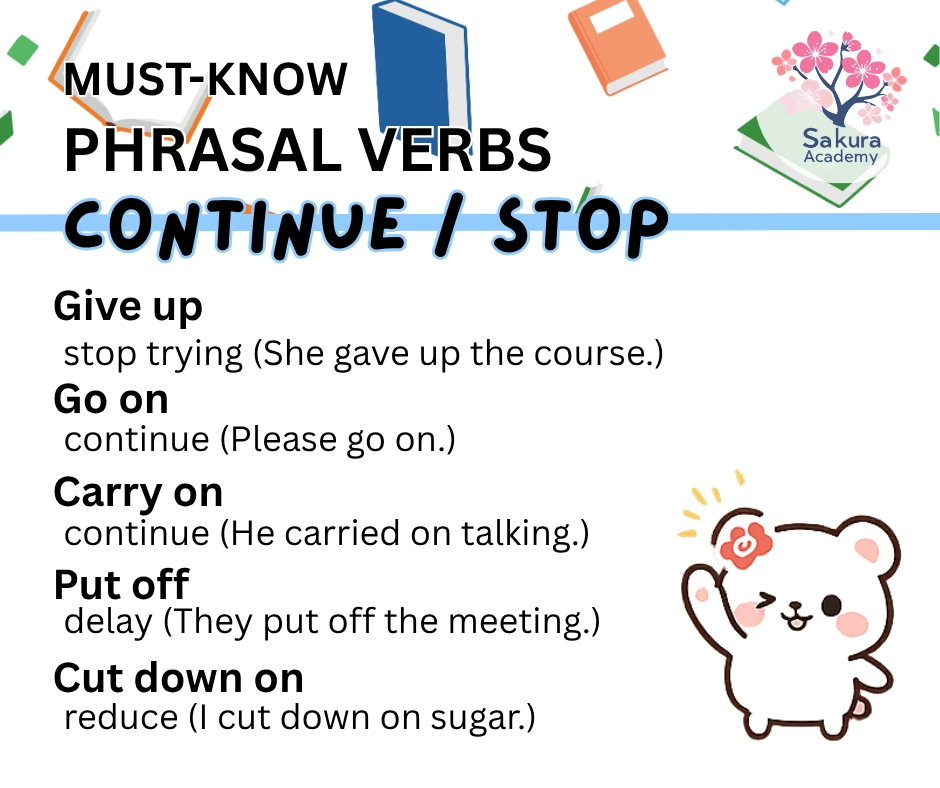
- He gave up (smoke) __ two years ago.
- We decided to stop (have) __ lunch after working for four hours straight.
- (Reading) _______ books regularly expands your vocabulary and knowledge.
Answer Key & Explanations:
- making (The verb 'admit' is followed by a gerund)
- to lock (Remember + To-Infinitive means to remember a task that needs to be done)
- smoking (Phrasal verbs like 'give up' take a gerund)
- to have (Stop + To-Infinitive means stopping an action in order to do another)
- Reading (Gerund acts as the subject of the sentence)
Wrap-Up from Sakura Academy
Mastering gerunds is an essential step towards natural and accurate English communication. Keep practicing these structures and review the example sentences regularly to excel in your English studies with Sakura Academy!
Nice, you reached the end. Want to keep going?
Here are a few smart picks to read next.