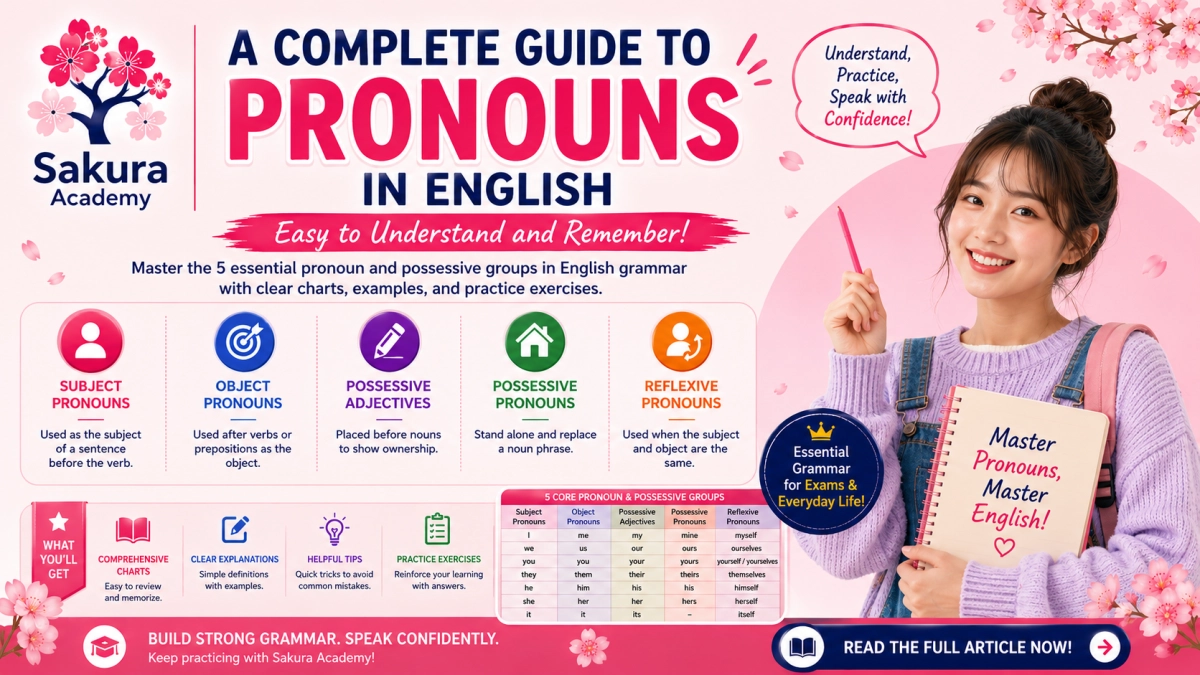
In English, repeating a noun multiple times not only makes sentences clumsy and overly long, but also removes the natural flow of communication. To solve this problem, Pronouns and Possessive Adjectives are used.
Let's systemize all 5 core groups with this comprehensive summary table and detailed guide from Sakura Academy below!
1. Master Summary Table of the 5 Core Pronoun & Possessive Groups
| Person / Category | Subject Pronouns | Object Pronouns | Possessive Adjectives (+ Noun) | Possessive Pronouns (Standalone) | Reflexive Pronouns |
|---|---|---|---|---|---|
| 1st Person (Singular) | I | me | my | mine | myself |
| 1st Person (Plural) | we | us | our | ours | ourselves |
| 2nd Person (Singular/Plural) | you | you | your | yours | yourself / yourselves |
| 3rd Person (Plural) | they | them | their | theirs | themselves |
| 3rd Person (Singular - Male) | he | him | his | his | himself |
| 3rd Person (Singular - Female) | she | her | her | hers | herself |
| 3rd Person (Singular - Object/Animal) | it | it | its | (Not used) | itself |
2. Detailed Definitions & Usage for Each Group
A. Subject Pronouns (Personal Pronouns)
- Position & Function: Placed at the beginning of a clause/sentence, functioning as the subject performing the action, and placed before the main verb.
- Example: She is studying Japanese at Sakura Academy.
B. Object Pronouns
- Position & Function: Placed after a verb or after a preposition (for, with, to, about...) to receive the action.
- Example:
- The teacher helped us with the homework.
- Look at him!
C. Possessive Adjectives
- Position & Function: Modifies the accompanying noun. MUST be followed immediately by a noun (
Possessive Adjective + Noun). - Example: This is my book.
D. Possessive Pronouns
- Position & Function: Replaces the entire phrase
Possessive Adjective + Nounto avoid repeating a previously mentioned noun. STANDS ALONE without any following noun. - Memory Formula:
Possessive Pronoun = Possessive Adjective + Noun - Example: Your car is red, but mine is blue. (mine = my car)
E. Reflexive Pronouns
- Position & Function:
- Used when the subject and object refer to the exact same person or thing (doing something to oneself).
- Used for emphasis to highlight that the subject performed the action independently without help (
by + Reflexive Pronounor placed right after the subject/at the end of the clause).
- Example:
- He cut himself while cooking.
- She solved the difficult problem by herself.
3. Tips to Distinguish Commonly Confused Pairs
- Its vs. It's:
Its: Possessive adjective of "it" (Example: The cat licked its paw).It's: Contraction for "It is" or "It has" (Example: It's raining).- Your vs. You're:
Your: Possessive adjective (Example: What is your name?)You're: Contraction for "You are" (Example: You're welcome).- Their vs. They're vs. There:
Their: Possessive adjective (Example: Their house).They're: Contraction for "They are".There: Refers to a place / existential structure (There is / There are).
4. Practice Exercises
Fill in the blanks with the most appropriate word:
- John is my friend. I saw _______ (he/him/his) at the library yesterday.
- This isn't my jacket. Is it __ (your/yours)?
- The students cleaned the classroom by __ (theirs/themselves).
- Anna loves painting. __ (Her/She) paintings are very beautiful.
- We enjoyed _______ (our/ourselves) at the party last night.
Answer Key & Explanations:
- him (Placed after the verb 'saw' as a direct object)
- yours (Possessive pronoun standing alone at the end of the sentence to replace 'your jacket')
- themselves (Follows 'by' to express doing something by oneself)
- Her (Possessive adjective placed directly before the noun 'paintings')
- ourselves (Fixed structure 'enjoy oneself': to have a great/fun time)
Wrap-Up from Sakura Academy
Mastering these 5 groups of pronouns is a fundamental yet essential step toward expressing English accurately, naturally, and confidently in your exams and daily life. Keep practicing consistently with Sakura Academy!
Nice, you reached the end. Want to keep going?
Here are a few smart picks to read next.