
Many English learners know grammar. They know vocabulary. They can understand textbook sentences.
But when they speak, something still feels strange.
The sentence may be correct, but it sounds too formal, too stiff, or too much like it was translated from Vietnamese.
This is a common problem for English learners, especially students who mostly learn from books, exercises, or school tests. They may know the “correct” word, but they do not always know the natural expression people actually use in daily conversation.
This is where phrasal verbs become useful.
What Are Phrasal Verbs?
Phrasal verbs are expressions made from a verb and one or more small words.
For example:
Give up means stop trying.
Look after means take care of.
Put off means delay.
Run into means meet someone unexpectedly.
At first, phrasal verbs can feel confusing because the meaning is not always easy to guess from the individual words.
For example, “give” and “up” are simple words, but “give up” has a different meaning.
That is why many learners avoid phrasal verbs. But in real English, they appear everywhere.
In conversations.
In movies.
In daily messages.
In IELTS Speaking.
In natural explanations.
If you want your English to sound less like a textbook and more like real communication, phrasal verbs are worth learning.
Why Phrasal Verbs Matter for IELTS Speaking
In IELTS Speaking, you do not need to use extremely difficult words all the time.
Actually, trying too hard to sound advanced can sometimes make your answer unnatural.
For example, a student may say:
“I decided to discontinue my participation in the activity.”
This is correct, but it sounds too formal for a normal speaking answer.
A more natural answer could be:
“I decided to give it up.”
Or:
“I stopped doing it because I was too busy.”
The goal is not to use phrasal verbs everywhere. The goal is to choose expressions that fit the situation.
Good English is not always complicated English.
Good English is clear, natural, and appropriate.
Learn Phrasal Verbs by Situation, Not by Long Lists
Many students try to memorize long lists of phrasal verbs.
This usually does not work.
The problem is that phrasal verbs are not just vocabulary items. They are expressions used in real situations. If you only memorize them from a list, you may recognize them in a test, but you may not be able to use them when speaking.
A better way is to learn them by topic.
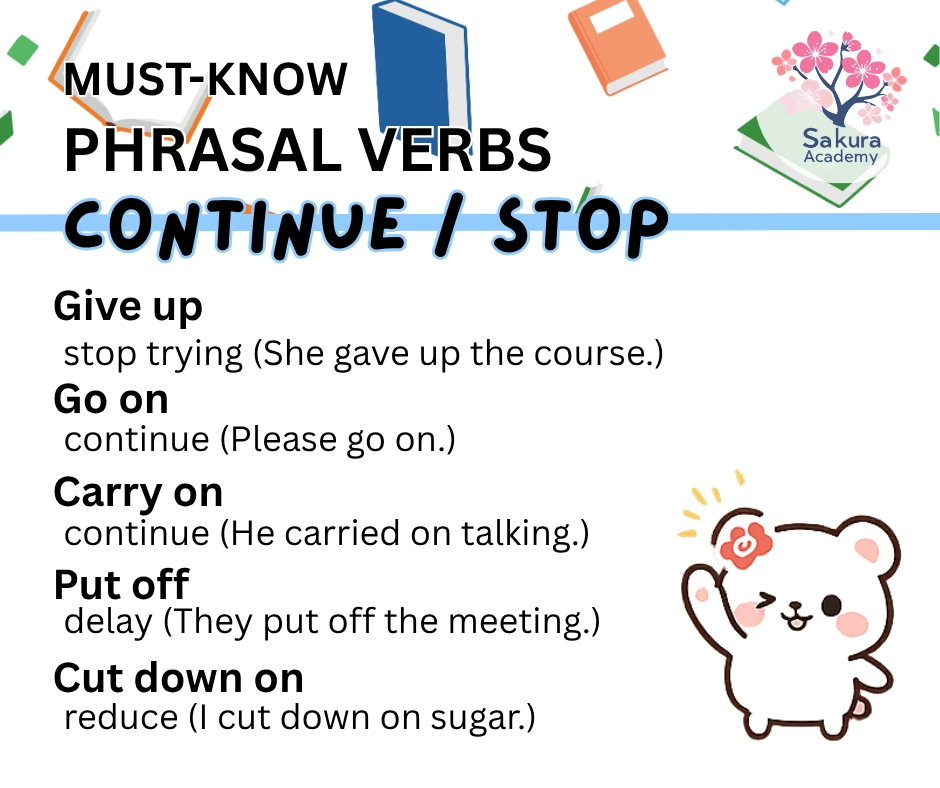
For daily habits, you can learn:
Give up
Go on
Carry on
Put off
Cut down on
These are useful when talking about study, routines, health, hobbies, or lifestyle.
For thinking and problem solving, you can learn:
Figure out
Work out
Come up with
Look up
These help when you explain ideas, decisions, school problems, or future plans.
For people and relationships, you can learn:
Get along with
Run into
Break up
Look after
These are useful when talking about friends, family, classmates, teachers, or daily life.
When you learn phrasal verbs by situation, they become easier to remember because they connect to real meaning.
How to Practise Phrasal Verbs Naturally
Do not try to learn twenty phrasal verbs in one day.
Start with three or four.
Then use them in your own sentences.
For example:
I want to give up junk food.
I need to cut down on screen time.
I looked up the word, but I still did not understand it.
I get along well with my classmates.
I came up with a new idea for my presentation.
After that, practise speaking the sentences out loud.
This step is important. Many students only write vocabulary in notebooks, but never train their mouth to actually say the words.
If you want to use phrasal verbs in IELTS Speaking, you need to practise saying them naturally, not just recognizing them on paper.
A Small Warning
Phrasal verbs are useful, but they are not magic.
Using many phrasal verbs does not automatically give you a high score. If you use them incorrectly, they can make your answer confusing.
For example, “look after” means take care of, but “look for” means search for. They are similar in form, but the meaning is different.
So the goal is not to use as many phrasal verbs as possible.
The goal is to use the right expression at the right time.
A few natural phrasal verbs used correctly are much better than many expressions used randomly.
Learn with Real Examples
At Sakura Academy, we help students learn vocabulary through context, examples, and speaking practice.
That means students do not only memorize a word. They learn when to use it, how to say it naturally, and how to apply it in real answers.
To help you get started, we created a visual post with useful phrasal verbs for English learners:
👉 English Must-Know Phrasal Verbs
Take a look and choose three expressions to practise today.
Do not only read them.
Use them in your own sentences.
Final Thoughts
If your English is correct but still sounds unnatural, the problem may not be your grammar.
It may be that you need more real expressions.
Phrasal verbs can help you sound more natural, understand everyday English better, and express your ideas more smoothly in speaking.
Start small. Learn by situation. Practise out loud. Use the expressions in real answers.
That is how vocabulary becomes communication.
At Sakura Academy, we help learners move from textbook English to real English, step by step.
Nice, you reached the end. Want to keep going?
Here are a few smart picks to read next.