Course Details
Course Objectives
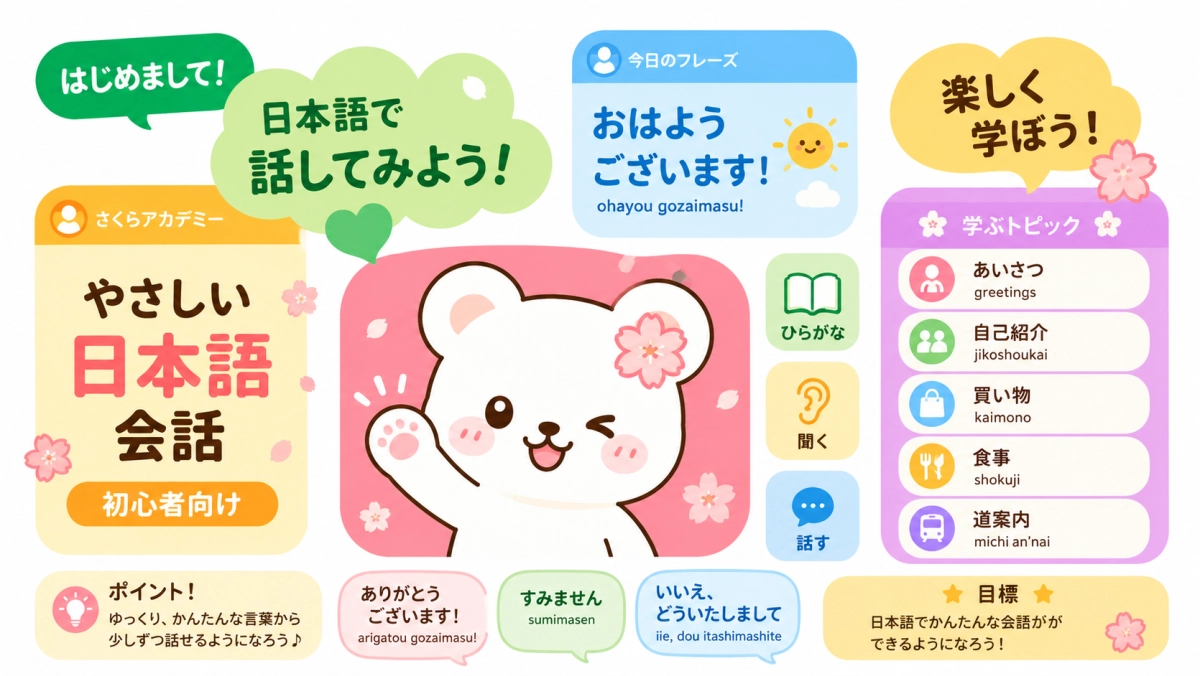
- Strengthen listening and speaking reflexes in everyday Japanese communication situations.
- Expand practical vocabulary and frequently used conversational sentence patterns.
- Improve pronunciation, fluency, and confidence when communicating with Japanese speakers.
- Develop understanding of basic Japanese communication culture and social manners.
- Encourage students to actively participate in conversations through interactive speaking practice.
Course Requirements
- Recommended for learners who already have basic Japanese knowledge (equivalent to JLPT N5 level or beginner foundation).
- Suitable for students who can read basic Hiragana and Katakana.
- Placement consultation may be conducted before enrollment to determine suitable class level.
Skill Targets
Listening
- Improve comprehension of daily conversations spoken at natural beginner-level speed.
- Develop the ability to identify key information, instructions, and common expressions in real-life situations.
Speaking
- Build confidence in introducing oneself, asking questions, expressing opinions, and maintaining simple conversations.
- Practice pronunciation, intonation, and natural Japanese speaking rhythm.
Vocabulary & Expressions
- Expand vocabulary related to daily life, transportation, shopping, restaurants, emergencies, and social interaction.
- Learn useful sentence structures and commonly used conversational expressions.
Cultural Communication
- Understand basic Japanese communication etiquette, greetings, politeness levels, and social behaviors.
- Develop awareness of communication styles commonly used in Japanese society.
Teaching Materials and Methodology
Learning Materials
- Topic-based materials customized to students’ proficiency levels
- Vocabulary and sentence-pattern flashcards
- Real-life communication audio and video resources
- Supplementary conversation worksheets
Teaching Methodology
- Pair and small-group conversation practice
- Role-play activities based on practical situations
- Pronunciation correction and personalized feedback
- Interactive speaking-focused lessons
- Continuous speaking assessments throughout the course
Assessment System
- Regular speaking tests and progress checks
- Continuous classroom participation evaluation
- Personalized instructor feedback after speaking activities
- Final speaking performance assessment at the end of each module
Syllabus Flexibility
- Lesson pacing, communication topics, and classroom activities may be adjusted based on students’ learning progress, communication goals, and overall classroom performance. Sakura Academy aims to provide a flexible and supportive learning environment tailored to each learner’s needs.
- For further information, placement consultation, or course inquiries, please contact Sakura Academy directly.