Japan is one of the most earthquake-prepared countries in the world. Buildings are designed around seismic standards, phones can receive Earthquake Early Warnings, transport operators have emergency procedures, and municipalities maintain evacuation plans.
None of this makes a powerful earthquake harmless.
The earthquake that struck Kumamoto Prefecture on 28 July 2026 is a reminder that the first few seconds matter - but so do the hours and days that follow. Collapsing structures are only one part of the danger. Fires, broken water systems, heat, aftershocks, damaged roads, unstable slopes and interrupted medical care can continue affecting people long after the main shaking stops.
What to do when the alert sounds
An Earthquake Early Warning may reach your phone, television, public-address system or train before strong shaking arrives. The available time can be only a few seconds, and people near the source may receive almost no useful warning. Do not spend those seconds searching for details.
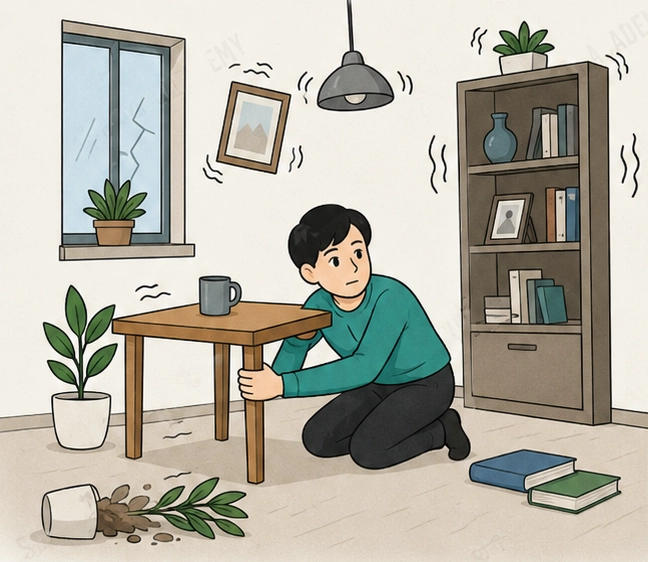
Drop, cover and hold on.
Get low so that the shaking does not knock you down. Protect your head and neck. Shelter beneath a sturdy table if one is within immediate reach, and hold a table leg so that your protection does not move away. Stay clear of windows, tall shelves, unsecured televisions and hanging objects.
Do not run outside while strong shaking is occurring. Exterior glass, tiles, signs and parts of building facades may fall into the street. Official Japanese guidance recommends taking cover beneath sturdy furniture, protecting the head and avoiding a panicked rush outdoors.
If you are inside a home, hotel, school or office
Remain in the safer part of the room until the strongest movement has passed. Move only a short distance when necessary to escape an immediate hazard such as glass or unstable furniture.
After the shaking weakens:
- Put on shoes before walking through broken glass.
- Open a door when it is safe to do so, helping preserve an exit if the frame becomes distorted.
- Check for fire, smoke or the smell of gas.
- Do not touch damaged electrical equipment or exposed wiring.
- Follow staff instructions in hotels, schools, stations and shopping centres.
- Do not use an elevator to evacuate.
Do not put yourself in danger trying to reach a stove or gas valve during violent shaking. Personal protection comes first.
If you are in an elevator
Press the buttons for every floor and leave at the first floor where the doors open safely. Do not force the doors or attempt to climb out between floors.
If the elevator stops and does not open, use the emergency call button or intercom. Stay calm and wait for instructions. Japanese fire-safety guidance specifically recommends pressing all floor buttons, leaving at the first stop and using the emergency communication system when trapped.
If you are on a train or bus
Hold a strap, handrail or seat. Protect your head where possible and follow the crew’s instructions.
Do not force doors open or enter the tracks. Rail services may stop for inspections even where there is no visible damage, and transport disruption can continue after the shaking.
If you are outside
Move away from:
- Windows and glass-fronted buildings.
- Hanging signs and vending-machine surrounds.
- Concrete-block walls.
- Roof tiles.
- Utility poles and overhead wires.
- Cliffs, steep slopes and riverbanks.
Protect your head with a bag or your arms. Do not shelter directly beside a building facade.
If you are near the sea or a river
A tsunami advisory was issued for the Ariake and Yatsushiro Sea after the Kumamoto earthquake, but it was lifted at 18:10 JST on 28 July. That past advisory is not a permanent warning. Always check the current Japan Meteorological Agency (JMA) status.
The correct general rule remains:
If you experience strong or prolonged shaking near the coast - or receive a tsunami warning or advisory - move immediately to higher ground or a designated tsunami evacuation building.
Do not wait to see the sea withdraw. Do not go to the waterfront to watch. Tsunami waves can enter rivers and may arrive repeatedly. Stay away until the warning or advisory has officially been lifted.
After the main shaking
Expect aftershocks. A damaged building that survived the first earthquake may not survive another strong movement.
Before moving:
- Check yourself and nearby people for injuries.
- Put on sturdy footwear.
- Watch for broken glass, damaged ceilings and unstable walls.
- Avoid elevators.
- Stay away from visibly damaged buildings.
- Keep away from cliffs and slopes, especially after rain.
- Listen for evacuation instructions.
- Use flashlights rather than candles where a gas leak may be possible.
In the Kumamoto region, JMA specifically warned that damaged buildings and loosened slopes remained vulnerable, and that the location of later earthquakes could produce shaking as strong as - or stronger than - the original event in some places.
When should you evacuate?
Not every earthquake requires everyone to leave immediately. Running outside without knowing the hazard can expose you to falling objects.
Evacuate promptly when:
- A local authority issues an evacuation instruction.
- Your building is visibly damaged or unsafe.
- There is fire, smoke or a suspected gas leak.
- You are in a tsunami-risk area after strong or prolonged shaking.
- A landslide, flood or structural-collapse risk affects your location.
- Hotel, station or facility staff direct you to leave.
Use stairs rather than elevators. Take essential medicine, identification, your phone, a charger, water and suitable clothing, but do not delay an urgent evacuation to collect possessions.
Preparing before an earthquake
Residents should keep enough water and food for at least three days, with approximately one week preferable when storage permits. Japanese government guidance uses approximately three litres of water per person per day as a household planning figure.
A practical emergency supply should include:
- Drinking water and food that requires little preparation.
- Prescription medicine and a copy of important medical information.
- Flashlight and spare batteries.
- Power bank and charging cables.
- Portable radio.
- Cash, including coins.
- Identification and copies of essential documents.
- First-aid supplies.
- Masks, hygiene products and emergency toilet bags.
- Work gloves and sturdy shoes.
- Seasonal protection, especially cooling supplies during Japan’s summer.
Secure tall furniture to the wall, keep heavy objects off high shelves and avoid placing large furniture where it can fall across a bed or exit.
Information for international residents and visitors
Install the official Safety tips application before travelling. It distributes Earthquake Early Warnings, tsunami information and other emergency alerts, and supports Vietnamese as well as English and several other languages.
Remember Japan’s main emergency numbers:
119 — Fire and ambulance
110 — Police
Save the address of your accommodation in Japanese. Learn where its emergency stairs and assembly point are located. Keep your phone charged, carry identification and retain some cash because card terminals and cash machines may stop working during a power or communications failure.
A serious earthquake in one region does not automatically mean that every part of Japan has suffered the same damage. Check your exact destination, railway route, airport and accommodation through JMA, the relevant municipality, JNTO and the operating transport company rather than relying on dramatic or undated social-media posts.
The central lesson
Japan’s systems can provide warnings, engineering protection and organised emergency responses. They cannot choose your first action for you.
When shaking begins:
Protect your head. Get low. Take cover. Hold on.
When it stops:
Check the danger around you. Expect aftershocks. Follow verified instructions.
And before the next earthquake:
Know your route, secure your home and prepare enough supplies to remain independent when water, electricity and transport are interrupted.
Nice, you reached the end. Want to keep going?
Here are a few smart picks to read next.