
For many English learners, one of the biggest challenges is not vocabulary or grammar - it is sounding natural.
You may know many words, but when you speak, your sentences still feel “textbook-like” or unnatural. This is exactly where phrasal verbs become essential.
Phrasal verbs are a key part of everyday English. Native speakers use them constantly in daily conversations, and they also appear frequently in exams like IELTS.
Why Are Phrasal Verbs So Important?
Learning phrasal verbs helps you sound more natural and fluent, understand real-life conversations better, and improve your IELTS Speaking performance.
Instead of using formal or complicated vocabulary, phrasal verbs allow you to express ideas in a simple and natural way.
Learn Phrasal Verbs by Real-Life Topics
At Sakura Academy, we recommend learning phrasal verbs by context, not by memorization. Here are some key groups:
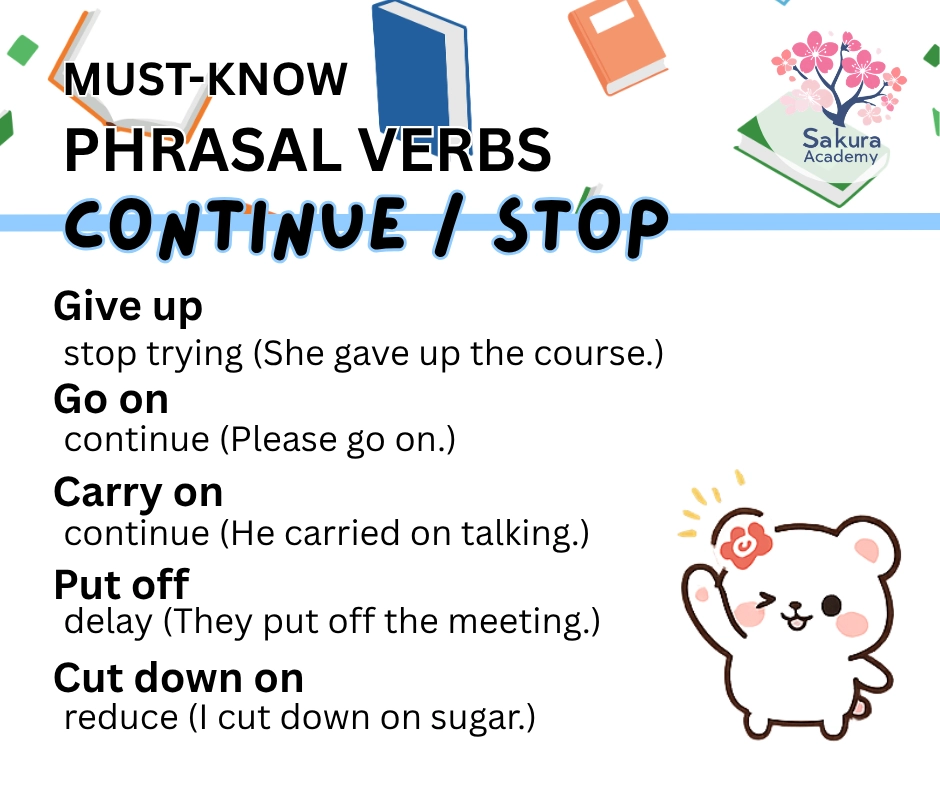
1. Continue / Stop Actions
These are useful for daily conversations and expressing habits:
- Give up (stop trying)
- Go on / Carry on (continue)
- Put off (delay)
- Cut down on (reduce)
2. Thinking and Understanding
Perfect for expressing opinions and ideas:
- Figure out (understand)
- Work out (solve)
- Come up with (think of an idea)
- Look up (search for information)
3. Social and Relationships
Useful for describing people and interactions:
- Get along (with) (have a good relationship)
- Run into (meet unexpectedly)
- Break up (end a relationship)
- Look after (take care of)
4. Daily Actions
Essential for everyday communication:
- Turn on / Turn off (start/stop a device)
- Take off / Put on (clothes or movement)
- Fill in (complete a form)
5. Additional High-Value Phrasal Verbs
- Call off (cancel)
- Make up (invent or reconcile)
- Settle down (become stable)
- Show up (arrive)
- Back up (support)
- Drop out (quit school/course)
How to Learn Phrasal Verbs Effectively
Many students try to memorize long lists, but this rarely works.
Instead, you should:
- Learn a few expressions each day
- Create your own sentences
- Practice speaking out loud
- Use them in real conversations
Practice with Sakura Academy
To help you learn better, we have created visual materials and examples in the post below:
👉 English Must-Know Phrasal Verbs
Take a look and try to apply these expressions in your own sentences.
Final Thoughts
You don’t need complicated vocabulary to sound fluent in English.
What you really need is:
- Natural expressions
- Daily practice
- Confidence in communication